A household under repeated attack
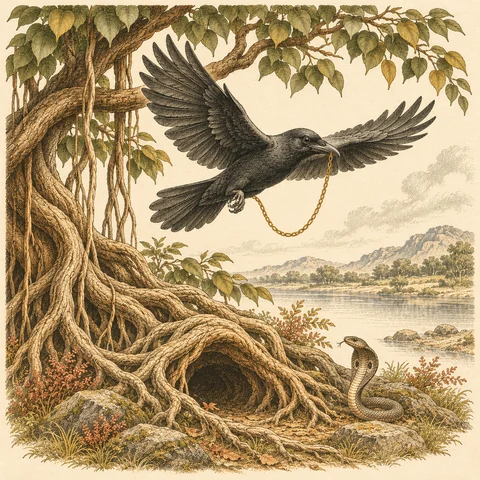
A black snake living in a banyan’s hollow trunk eats the crow pair’s chicks. The crow-hen wants to move, while her mate remains attached to their established home. He seeks a jackal’s advice instead of confronting the snake directly. The eventual gold chain belongs to that search for a practicable response to unequal strength. It is not a protective charm, a divine reward, or a treasure the birds intend to keep for their own enjoyment.
Source: Panchatantra, Book 1: The Loss of Friends · Book I, How the Crow-Hen Killed the Black Snake: nest, losses, and consultation
A theft meant to be followed
The jackal proposes stealing an expensive ornament where powerful people can pursue the thief. The crow-hen finds women of a royal household bathing, takes a gold chain left on the bank, and carries it toward the tree. Men armed with clubs follow. She drops the chain into the snake’s hole and waits at a safe distance. The conspicuous flight matters: an undetected theft would bring no human force to the place where it is needed.
Source: Panchatantra, Book 1: The Loss of Friends · Book I, How the Crow-Hen Killed the Black Snake: advice and theft after The Heron That Liked Crab-Meat
What the pursuers find
Searching the hollow for the chain, the king’s men encounter the hooded snake, kill it, recover the ornament, and leave. The crow pair can remain in their home. Ryder’s completed action specifies a gold chain, although the earlier advice allows more than one kind of ornament. Victor tells the episode to support his confidence in indirect methods. Its defensive success is thus placed inside a frame where another use of cunning will destroy a friendship rather than protect vulnerable young.
Source: Panchatantra, Book 1: The Loss of Friends · Book I, How the Crow-Hen Killed the Black Snake: recovery of the chain and return to Victor’s argument
- Period / witness
- Purnabhadra recension dated 1199 CE; Arthur W. Ryder translation published 1925. These dates identify textual witnesses, not the first telling of every episode.
- Recording context
- Panchatantra in Arthur W. Ryder’s 1925 English translation of the Purnabhadra recension; passages are identified by book, named tale, and the surrounding frame narrative.
A recording location is not necessarily a story’s origin. Dates of texts, copies, and translations answer different questions.
Explore time & place →Read the sources
These references support the explanation above. Rights and edition notes are recorded individually.
Panchatantra, Book 1: The Loss of Friends ↗
Pūrṇabhadra recension (1199 CE); English translation by Arthur W. Ryder (1877–1938), based on Johannes Hertel’s Sanskrit edition · Pūrṇabhadra recension 1199 CE; Hertel edition 1908; Ryder translation 1925
Edition & rights note