A home becomes a trap
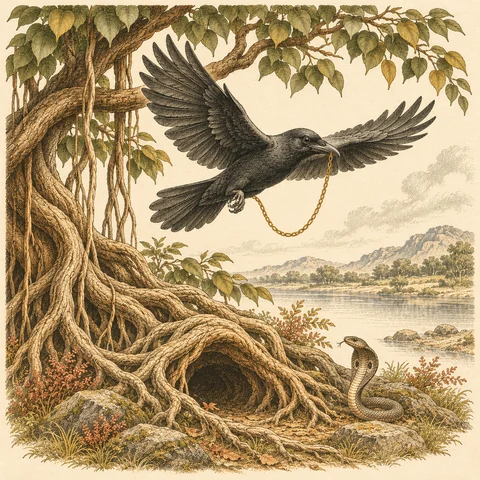
A crow and his mate nest in a banyan tree, but a black snake living in its hollow repeatedly eats their young. The crow-hen urges that they move somewhere safer. Her mate is attached to the familiar tree and seeks a way to remain there without losing another brood.
He consults a friendly jackal whose learning and practical judgment may supply what the birds lack in strength. Before proposing a plan, the jackal tells the story of a heron undone by a crab. That inserted narrative demonstrates that a predator’s advantage can be reversed. It also delays the answer until the crow has been shown why a carefully chosen device might work.
Source: Panchatantra, Book 1: The Loss of Friends · Panchatantra, Book 1, How the Crow-Hen Killed the Black Snake, including conclusion after The Heron That Liked Crab-Meat, pp. 74–81
A theft with a particular destination
The jackal advises stealing a valuable ornament from someone whose servants will pursue it, then placing it where its recovery will bring the snake into danger. The crow-hen finds women of a royal household bathing. Their jewelry lies on the bank, and she carries away a gold chain.
Attendants follow her with clubs. She flies to the nesting tree and drops the chain into the snake’s hole before waiting at a safe distance. When the men climb up to retrieve the ornament, they encounter the hooded snake. They kill it, recover the chain, and leave. The birds can then occupy their old home in peace.
Source: Panchatantra, Book 1: The Loss of Friends · Panchatantra, Book 1, How the Crow-Hen Killed the Black Snake, including conclusion after The Heron That Liked Crab-Meat, pp. 74–81
Borrowed strength
The crow-hen does not persuade the attendants to protect her nest. Instead, she arranges matters so that their own purpose brings about the result she needs. The ornament is returned to its owners; its importance to the plot is its ability to attract pursuit, not its value as a reward for the birds.
The surrounding narrative uses this episode to illustrate strategy where direct force would fail. Its success also depends on cooperation: the female bird first identifies the danger, the male seeks advice, the jackal designs the device, and she executes it. Reading only a maxim about cleverness would miss the several contributions that make the plan possible, as well as the earlier option of leaving the tree.
Source: Panchatantra, Book 1: The Loss of Friends · Panchatantra, Book 1, How the Crow-Hen Killed the Black Snake, including conclusion after The Heron That Liked Crab-Meat, pp. 74–81
- Period / witness
- Pūrṇabhadra recension dated 1199 CE; Arthur W. Ryder translation, 1925. The tales have differing earlier histories.
- Recording context
- Original synopsis and commentary on Ryder’s translation of the Pūrṇabhadra recension, edited by Johannes Hertel. This selected literary witness does not represent all Indian traditions.
A recording location is not necessarily a story’s origin. Dates of texts, copies, and translations answer different questions.
Explore time & place →Read the sources
These references support the explanation above. Rights and edition notes are recorded individually.
Panchatantra, Book 1: The Loss of Friends ↗
Pūrṇabhadra recension (1199 CE); English translation by Arthur W. Ryder (1877–1938), based on Johannes Hertel’s Sanskrit edition · Pūrṇabhadra recension 1199 CE; Hertel edition 1908; Ryder translation 1925
Edition & rights note