A broken branch and an unanswered grief
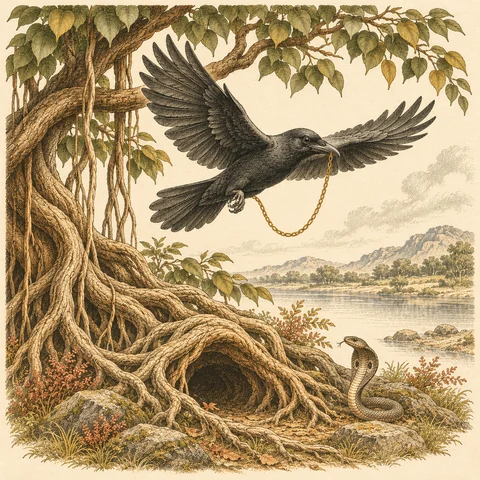
An elephant suffering in the heat takes shelter beneath a tamal tree. He pulls down the branch holding a sparrow’s nest, crushing its eggs. The parent birds escape, but their young are lost. A woodpecker, hearing the female’s lament, initially offers teachings about the futility of mourning what cannot be restored.
She rejects that as an adequate response to her situation. If he is her friend, she says, he should help devise a way to punish the elephant. The discussion turns from controlling grief to acting on the injustice that produced it. Friendship is tested by whether it can supply practical assistance, not only consoling language.
Source: Panchatantra, Book 1: The Loss of Friends · Panchatantra, Book 1, The Duel Between Elephant and Sparrow, pp. 153–157
Different capacities in one sequence
The woodpecker brings in a gnat called Lute-Buzz. She in turn recommends consulting her friend Cloud-Messenger, a frog. The frog coordinates a plan in which each participant’s ordinary ability has a specific place.
First the gnat sings in the elephant’s ear. Enjoying the sound, he closes his eyes; the woodpecker then blinds him. As the injured animal wanders in the midday heat, the frog croaks beside a deep pit. The elephant associates the sound with water and approaches in search of relief. Unable to see the ground ahead, he falls into the pit and dies. No single member of the alliance needs to overpower his body directly.
Source: Panchatantra, Book 1: The Loss of Friends · Panchatantra, Book 1, The Duel Between Elephant and Sparrow, pp. 153–157
Cooperation with a violent purpose
The plan succeeds because its steps depend on one another. Sound creates the opening for the attack on sight; thirst gives the final sound its misleading meaning. The elephant’s strength cannot compensate for the information he has lost.
Constance tells this episode to Sprawl when urging him to enlist other birds against the ocean. Its function there is to show what small allies can accomplish collectively. Yet this is a revenge story, not an uncomplicated celebration of teamwork. The eggs remain dead, and the alliance’s achievement is the killer’s destruction. Keeping that outcome visible prevents the practical lesson about coordination from erasing the grief and retaliatory violence that give the story its force.
Source: Panchatantra, Book 1: The Loss of Friends · Panchatantra, Book 1, The Duel Between Elephant and Sparrow, pp. 153–157
- Period / witness
- Pūrṇabhadra recension dated 1199 CE; Arthur W. Ryder translation, 1925. The tales have differing earlier histories.
- Recording context
- Original synopsis and commentary on Ryder’s translation of the Pūrṇabhadra recension, edited by Johannes Hertel. This selected literary witness does not represent all Indian traditions.
A recording location is not necessarily a story’s origin. Dates of texts, copies, and translations answer different questions.
Explore time & place →Read the sources
These references support the explanation above. Rights and edition notes are recorded individually.
Panchatantra, Book 1: The Loss of Friends ↗
Pūrṇabhadra recension (1199 CE); English translation by Arthur W. Ryder (1877–1938), based on Johannes Hertel’s Sanskrit edition · Pūrṇabhadra recension 1199 CE; Hertel edition 1908; Ryder translation 1925
Edition & rights note