Trees placed in their environments
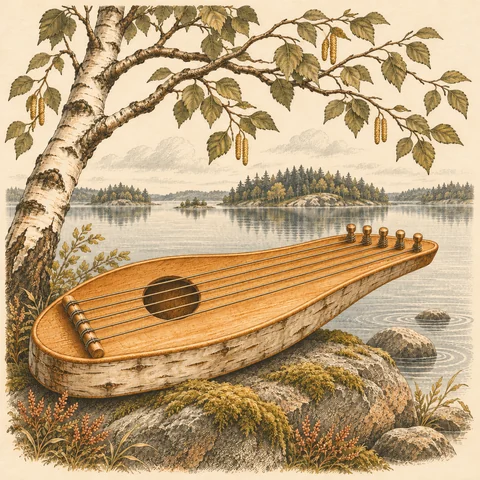
After Väinämöinen’s arrival, Sampsa Pellervoinen is sent to sow the land. The catalogue distributes trees across different kinds of ground, making vegetation differentiated rather than a single mass of greenery. The oak’s exceptional growth then disrupts the balance established by this spreading of life.
Sampsa’s work precedes the barley cultivation that Väinämöinen later undertakes. Sowing trees and establishing grain are related activities, but the runo gives them different participants and stages. The distinction helps prevent the famous singer from absorbing every creative act performed around him.
Source: Kalevala, The Land of the Heroes, Volume One · Runo II, lines 1–110 and 225–378
Listening before cutting
In the boat-building episode, Sampsa searches for suitable wood. Trees answer questions about whether their substance can serve the intended purpose. The eventual choice of oak follows this examination, and Sampsa fells and prepares the timber.
The scene presents material selection as a conversation with the living landscape. It is not simply an inventory of trees to be consumed. Sampsa’s two appearances connect planting with selective cutting: useful craft depends on knowing how growth differs from place to place and tree to tree. The text provides these roles without an extensive family history or a separate sequence of cult legends.
Source: Kalevala, The Land of the Heroes, Volume One · Runo XVI, lines 1–100
- Period / witness
- Elias Lönnrot’s expanded Kalevala, 1849; W. F. Kirby’s English translation first published 1907. Narrative time is not a historical date.
- Recording context
- A nineteenth-century literary compilation based on Finnish, Karelian, and Ingrian oral poetry. These entries describe the selected compiled epic, not a single unchanged oral text or every living tradition.
A recording location is not necessarily a story’s origin. Dates of texts, copies, and translations answer different questions.
Explore time & place →Read the sources
These references support the explanation above. Rights and edition notes are recorded individually.
Kalevala, The Land of the Heroes, Volume One ↗
Elias Lönnrot (compiler, 1802–1884); translated by William Forsell Kirby (1844–1912) · Expanded Finnish compilation 1849; translation first published 1907; digitized printing lists reprints through 1936
Edition & rights note