A sower’s excessive success
After Väinämöinen reaches land, he asks Sampsa Pellervoinen to sow trees across the country. Different kinds take root in suitable places, but the oak initially refuses to grow. Its eventual emergence requires another beginning, associated with cut grass, burning, and ashes. When it finally rises, its success exceeds every useful limit.
The oak spreads so widely that it prevents sunlight and moonlight from reaching the world. The problem is not a lack of fertility but a single growth that monopolizes the conditions of life. Väinämöinen looks for someone capable of cutting it down, and ordinary expectations about strength prove inadequate.
Source: Kalevala, The Land of the Heroes, Volume One · Runo II, lines 1–110
The small figure who grows
A tiny copper-clad figure comes out of the sea carrying an axe. Väinämöinen doubts that such a small being can manage the enormous tree. The stranger then grows into a towering worker and strikes the oak. With its fall the sky becomes visible again, and pieces of the tree acquire powers or travel into other stories.
The episode reverses two measures of size. The huge tree is a threat because it excludes others, while the apparently insignificant helper possesses the force needed to restore a shared environment. The hero’s first judgment of the helper is therefore unreliable. Restoring order requires recognizing a capability that appearances conceal.
Source: Kalevala, The Land of the Heroes, Volume One · Runo II, lines 111–224
Making room for cultivation
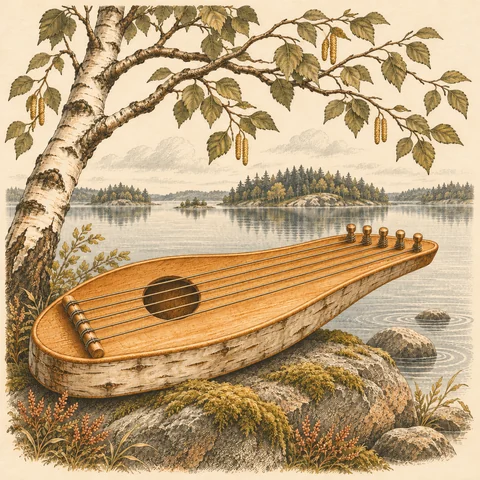
Plants and birds now flourish, but barley still needs deliberate work. Väinämöinen finds seed and clears woodland, leaving one birch for birds to rest in. An eagle rewards this consideration by providing fire for the clearing. Väinämöinen sows and asks Ukko for rain; the grain grows.
The narrative ends in cultivation rather than another battle. Its sequence links useful growth to light, selective clearing, animal assistance, and rainfall. Leaving a tree standing is as consequential as felling one. This is a literary account of an inhabited landscape’s beginnings, not a complete historical description of Finnish farming. Within the poem, abundance emerges from several coordinated acts rather than from limitless growth alone.
Source: Kalevala, The Land of the Heroes, Volume One · Runo II, lines 225–378
- Period / witness
- Elias Lönnrot’s expanded Kalevala, 1849; W. F. Kirby’s English translation first published 1907. Narrative time is not a historical date.
- Recording context
- A nineteenth-century literary compilation based on Finnish, Karelian, and Ingrian oral poetry. These entries describe the selected compiled epic, not a single unchanged oral text or every living tradition.
A recording location is not necessarily a story’s origin. Dates of texts, copies, and translations answer different questions.
Explore time & place →Read the sources
These references support the explanation above. Rights and edition notes are recorded individually.
Kalevala, The Land of the Heroes, Volume One ↗
Elias Lönnrot (compiler, 1802–1884); translated by William Forsell Kirby (1844–1912) · Expanded Finnish compilation 1849; translation first published 1907; digitized printing lists reprints through 1936
Edition & rights note