Seen at a particular moment
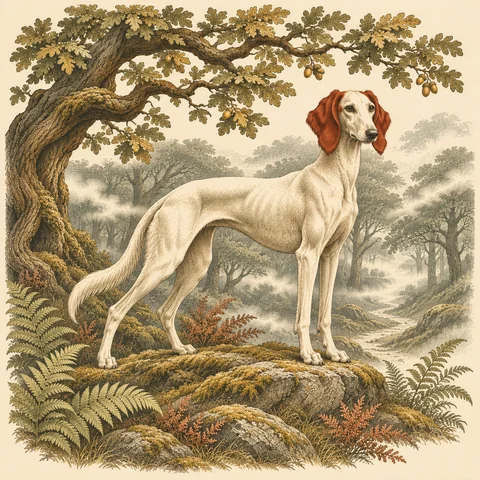
Pwyll encounters the hounds while separated from his own companions. They have brought down a stag, and their brilliant white bodies and red ears astonish him. The narrator pauses over the contrasting colors before Pwyll acts. These are Arawn's hunting animals within a specific encounter. The description does not by itself define every white animal, red-eared creature, or supernatural pack in Welsh narrative.
Source: Pwyll Prince of Dyved — Guest translation · Pwyll Prince of Dyved: description of the unfamiliar hounds at the stag
Ownership and courtesy
Pwyll drives the pack away and substitutes his own dogs. Arawn's objection concerns this conduct, not Pwyll's failure to recognize a divine sign. That distinction matters: extraordinary appearance does not remove ordinary obligations. The hounds make the visitor notice a marvel, but his response exposes a fault already meaningful within aristocratic hunting culture. His later adventure begins as an attempt to repair that specific offense.
Source: Pwyll Prince of Dyved — Guest translation · Pwyll Prince of Dyved: driving off the hounds and Arawn’s charge of discourtesy
The limits of an attractive image
The selected episode neither describes a chase after human souls nor identifies these dogs with every later tradition called the hounds of Annwn. It supplies color, ownership, hunting behavior, and a role in establishing friendship between rulers. An illustration may emphasize their uncanny beauty, but an explanation should retain the social action surrounding them. Otherwise a memorable visual detail replaces the reason they matter to the plot.
Source: Pwyll Prince of Dyved — Guest translation · Pwyll Prince of Dyved: opening hunt through agreement with Arawn
- Period / witness
- Medieval Welsh prose preserved in fourteenth-century manuscript collections; Guest translation 1838–1849.
- Recording context
- A named Welsh literary tale, read through Guest’s historical English translation. Medieval Christian narrative language and the translator’s omissions and vocabulary remain part of this witness; its setting does not date a first oral telling.
A recording location is not necessarily a story’s origin. Dates of texts, copies, and translations answer different questions.
Explore time & place →Read the sources
These references support the explanation above. Rights and edition notes are recorded individually.
Pwyll Prince of Dyved — Guest translation ↗
Anonymous Welsh narrative; translated by Lady Charlotte Guest (later Lady Charlotte Schreiber, 1812–1895) · Guest translation first published in the 1838–1849 Mabinogion series; historical reprint transcribed by Gutenberg; digital edition updated 4 October 2021
Edition & rights note