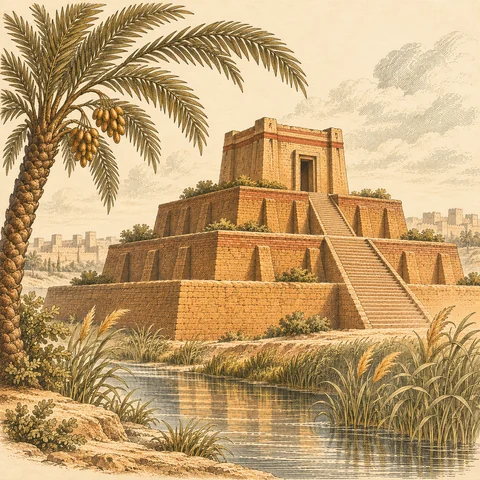
The moving light and its great titles
The bilingual hymn calls upon Sin or Nannar through repeated paternal address and images of strength, beauty, and abundant life. His passage across heaven opens a way and grants light. The speaker associates his effective word with vegetation, thriving animals, truth, and the ordering of divine and human affairs.
Such language is intentionally expansive. A hymn’s declaration that its addressee is incomparable belongs to a performance of praise, not necessarily to a systematic table ranking all gods. Its imagery draws the distant celestial presence into the conditions that make earthly life dependable.
Source: Cuneiform Parallels to the Old Testament: selected primary translations · Hymn to Sin, lines 1–35, pp. 141–146
A universal appeal returns to Ur
Near the end, the prayer asks the god to look upon his temple and city, specifically Ur and its sanctuary. Other divine figures are invited to ask him to be appeased. The immense scale of the earlier titles narrows into a local request for attention and restored favor.
The colophon says the tablet was copied and checked and names a scholar connected with Ashurbanipal’s court. That information concerns the surviving transmission, not the first moment anyone sang to the moon. It is valuable precisely because it keeps both levels visible: the literary world of divine care and the scribal work through which the composition was preserved.
Source: Cuneiform Parallels to the Old Testament: selected primary translations · Lines 36–48 and colophon, pp. 146–147
- Period / witness
- Ancient bilingual hymn; surviving colophon associated with the seventh-century BCE court of Ashurbanipal; English edition 1912.
- Recording context
- The copied-and-checked colophon names Ishtar-shuma-eresh, a scholar of Ashurbanipal. This identifies a stage of textual preservation rather than the original composition or first performance.
A recording location is not necessarily a story’s origin. Dates of texts, copies, and translations answer different questions.
Explore time & place →Read the sources
These references support the explanation above. Rights and edition notes are recorded individually.
Cuneiform Parallels to the Old Testament: selected primary translations ↗
Robert William Rogers, translator and editor (1864–1930) · 1912 English edition of selected cuneiform texts and a Greek-mediated Berossos account; ancient witnesses vary by composition.
Edition & rights note