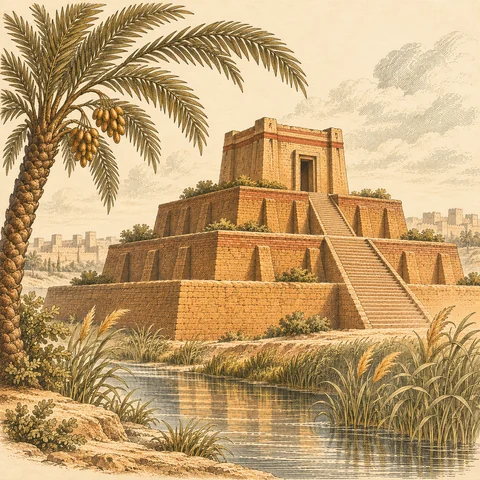
Seven gates and a hostile arrival
Ishtar approaches the enclosed realm of Ereshkigal and demands admission. She threatens to break its barriers and bring up the dead if the gatekeeper refuses. The porter reports her arrival, and Ereshkigal orders that the established entry procedures be followed.
At seven successive gates, an ornament or garment is removed. Ishtar questions each loss and repeatedly receives the answer that this is the realm’s rule. By the time she reaches the queen, the visible equipment of her authority has been taken away. Ereshkigal orders Namtar to afflict and confine her. The visitor’s powerful declaration at the outer gate has not exempted her from another sovereign’s jurisdiction.
Source: Cuneiform Parallels to the Old Testament: selected primary translations · Ishtar’s Descent, obverse 1–75, pp. 121–126
The consequences reach the living
While Ishtar remains below, sexual activity ceases among animals and people. The poem makes the stoppage concrete through cattle, donkeys, and separated human partners. Her absence therefore matters beyond the quarrel between the two goddesses. The world above needs a change in the situation.
Ea creates an emissary, Asushunamir, to approach Ereshkigal and obtain the means of release. The exchange turns hostile when the visitor asks for a particular water container. Ereshkigal pronounces a curse on the emissary, but orders Namtar to sprinkle Ishtar with life-giving water. Release is secured through negotiation and a costly intervention rather than through Ishtar breaking the gates by force.
Source: Cuneiform Parallels to the Old Testament: selected primary translations · Obverse 76–80; reverse 1–38, pp. 126–129
A return with an obscure ending
Ishtar ascends through the gates and receives her clothing and ornaments back in reverse order. The closing lines then turn toward Tammuz, music, mourning, and the dead. Their connections are difficult, and Rogers himself marks the ending as obscure. A smooth tale in which every closing line supplies an unambiguous explanation would exceed this witness.
The Akkadian poem is related to the Sumerian descent of Inana, but the two should not be pasted together. In this account the reproductive stoppage is prominent, Ea sends one named emissary, and Ishtar is afflicted with diseases. The Sumerian poem gives its own account of death, rescue, and substitution. Reading the Akkadian narrative on its own preserves its movement from threatened invasion to disempowerment, intervention, and restored passage.
Source: Cuneiform Parallels to the Old Testament: selected primary translations · Reverse 39–58 and Rogers’s notes on the ending, pp. 129–131
- Period / witness
- Selected Sumerian and Akkadian literary witnesses, with a separately identified Greek-mediated account; modern editions 1912, 1920, and 1998–2001. Narrative time is not a historical date.
- Recording context
- Selected cuneiform compositions in Robert W. Rogers’s 1912 edition. Individual tablets, languages, and textual gaps are distinguished in the article; this is not a single Mesopotamian canon.
A recording location is not necessarily a story’s origin. Dates of texts, copies, and translations answer different questions.
Explore time & place →Read the sources
These references support the explanation above. Rights and edition notes are recorded individually.
Cuneiform Parallels to the Old Testament: selected primary translations ↗
Robert William Rogers, translator and editor (1864–1930) · 1912 English edition of selected cuneiform texts and a Greek-mediated Berossos account; ancient witnesses vary by composition.
Edition & rights note