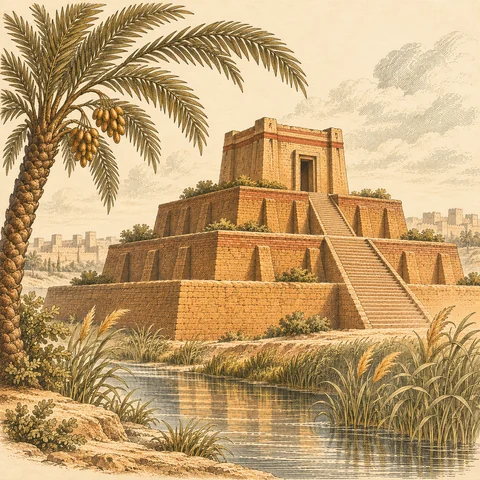
A place described through deprivation
The Akkadian descent introduces the destination as a place without ordinary light, where dust and clay characterize the inhabitants’ condition. This description establishes a radical change in the terms of existence before Ishtar reaches the gates.
The barriers then make the change procedural. Entry involves a porter, a report to the queen, and repeated removal of ornaments. A visitor’s dignity elsewhere is not sufficient to carry her unchanged through these thresholds. The phrase no return names a powerful norm, but the story explores what happens when an exceptional visitor and outside helpers put that norm under pressure.
Source: Cuneiform Parallels to the Old Testament: selected primary translations · Ishtar’s Descent, obverse 1–62, pp. 121–125
Different routes do not make one map
The Amarna Nergal account gives another route into Ereshkigal’s domain, including the stationing of fourteen companions at doors. That detail should not be forced into the seven-gate pattern of Ishtar’s descent. The texts are staging different encounters, not providing matching architectural surveys.
Both make authority below legible through a queen, messengers, admissions, and orders. Yet neither authorizes a single complete map of every Mesopotamian idea about death. The most productive comparison concerns passage and jurisdiction: what a visitor must surrender, which powers can intervene, and how a successful departure changes relations between the living or divine worlds.
Source: Cuneiform Parallels to the Old Testament: selected primary translations · Nergal and Ereshkigal, lines 51–87, pp. 133–135
- Period / witness
- Selected Sumerian and Akkadian literary witnesses, with a separately identified Greek-mediated account; modern editions 1912, 1920, and 1998–2001. Narrative time is not a historical date.
- Recording context
- Selected cuneiform compositions in Robert W. Rogers’s 1912 edition. Individual tablets, languages, and textual gaps are distinguished in the article; this is not a single Mesopotamian canon.
A recording location is not necessarily a story’s origin. Dates of texts, copies, and translations answer different questions.
Explore time & place →Read the sources
These references support the explanation above. Rights and edition notes are recorded individually.
Cuneiform Parallels to the Old Testament: selected primary translations ↗
Robert William Rogers, translator and editor (1864–1930) · 1912 English edition of selected cuneiform texts and a Greek-mediated Berossos account; ancient witnesses vary by composition.
Edition & rights note