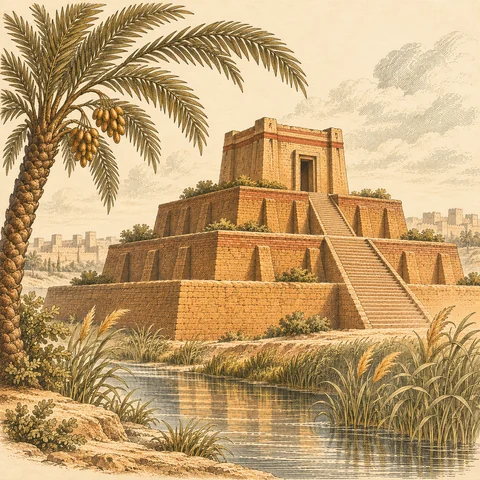
The city supplied by Adapa
The Adapa fragments repeatedly identify the protagonist with Eridu. His wisdom is expressed through the activities that sustain a divine household: preparing bread and water, attending to service, and going out to fish. The city is therefore not merely a label attached to his name.
Its needs help explain why he is on the water when the south wind strikes. The extraordinary heavenly hearing grows from work performed for a particular place. A retelling that begins only with the broken wind loses this connection between routine service, local obligation, and a disturbance that reaches the gods above.
Source: Cuneiform Parallels to the Old Testament: selected primary translations · Adapa fragment 1.5–22 and fragment 2.48–54, pp. 69–70, 75
A city among the world’s beginnings
The bilingual creation passage names Eridu within its movement from absent cities and sanctuaries toward an inhabited world. It also places the deep, sacred buildings, water, and human making within a sequence of construction.
The text’s ordering is theological and literary. It cannot by itself establish an archaeological chronology of settlement, prove the geographic origin of all creation narratives, or make every later mention of the city part of the same episode. What the comparison does reveal is a place imagined at two scales: the practical setting of a servant’s daily work and a significant name in the arrangement of the cosmos.
Source: Cuneiform Parallels to the Old Testament: selected primary translations · Bilingual creation text, lines 1–23, pp. 47–49
- Period / witness
- Selected Sumerian and Akkadian literary witnesses, with a separately identified Greek-mediated account; modern editions 1912, 1920, and 1998–2001. Narrative time is not a historical date.
- Recording context
- Selected cuneiform compositions in Robert W. Rogers’s 1912 edition. Individual tablets, languages, and textual gaps are distinguished in the article; this is not a single Mesopotamian canon.
A recording location is not necessarily a story’s origin. Dates of texts, copies, and translations answer different questions.
Explore time & place →Read the sources
These references support the explanation above. Rights and edition notes are recorded individually.
Cuneiform Parallels to the Old Testament: selected primary translations ↗
Robert William Rogers, translator and editor (1864–1930) · 1912 English edition of selected cuneiform texts and a Greek-mediated Berossos account; ancient witnesses vary by composition.
Edition & rights note