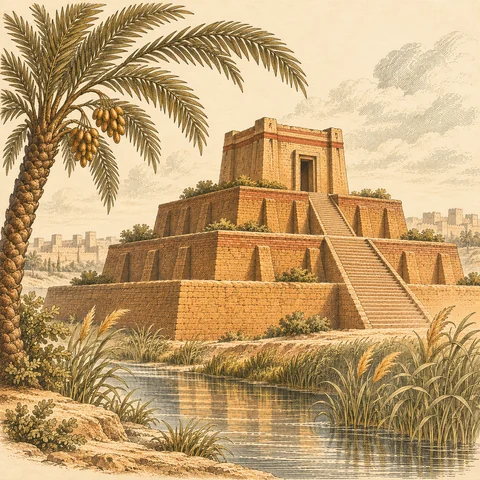
Before the places have been built
The passage begins by listing absent things: no reed or tree, no brick or mold, no house or city. Named sanctuaries are also missing. The repeated negatives make the world’s incompleteness recognizable through building materials and institutions that an audience already knows.
All lands are water. The account then names Eridu, Babylon, and Esagil as the ordered setting takes shape. This sequence should not be turned into an archaeological timetable of which historical city was founded first. It is a theological description of a world made fit for divine and human habitation, with sacred buildings carrying much of the meaning of creation.
Source: Cuneiform Parallels to the Old Testament: selected primary translations · Another Version of Creation by Marduk, the bilingual creation text, lines 1–16, pp. 47–48
A foundation laid upon water
Marduk spreads reedwork on the water and places earth upon it. The image resembles practical building with a support or platform: stable land emerges through an intelligible act of arrangement. He creates people to inhabit the world ordered for the gods, and Aruru participates in the making of humankind.
The sequence continues through living creatures, the Tigris and Euphrates, grasses, reeds, forests, fields, and domestic animals with their young. Naming and locating the rivers are part of the constructive work. The landscape is not an empty surface completed before life arrives; waterways, vegetation, animals, and settlements together constitute its useful and inhabited form.
Source: Cuneiform Parallels to the Old Testament: selected primary translations · Bilingual creation text, lines 17–30, p. 49
Creation inside an incantation
The surviving continuation mentions a dam and marshland, then becomes damaged. Its wider textual setting matters: this creation passage introduces an incantation associated with a temple. The recital of beginnings supports ritual activity in an already inhabited world. It is not simply an independent chapter of natural history.
Although Marduk is central here as in the great creation epic, this account does not narrate his combat with Tiamat. Replacing its reed platform with a defeated monster’s body would erase the composition’s distinctive imagery. The comparison instead shows how different selected texts can make one god a maker by different narrative means. One emphasizes conquest and command, while this passage dwells on foundations, water management, living growth, and the provision of places to dwell.
Source: Cuneiform Parallels to the Old Testament: selected primary translations · Bilingual creation text, lines 31–32 and introductory source note, pp. 47–49; compare Story of Creation IV.128–146
- Period / witness
- Ancient bilingual Sumerian-Akkadian incantation passage; tablet recovered in 1882; English edition 1912.
- Recording context
- Rogers identifies the tablet as recovered by Hormuzd Rassam at Abu-Habba (Sippar). It is a surviving ritual witness, not a contemporary report of the founding of Eridu or Babylon.
A recording location is not necessarily a story’s origin. Dates of texts, copies, and translations answer different questions.
Explore time & place →Read the sources
These references support the explanation above. Rights and edition notes are recorded individually.
Cuneiform Parallels to the Old Testament: selected primary translations ↗
Robert William Rogers, translator and editor (1864–1930) · 1912 English edition of selected cuneiform texts and a Greek-mediated Berossos account; ancient witnesses vary by composition.
Edition & rights note