A crafted part of a collective plan
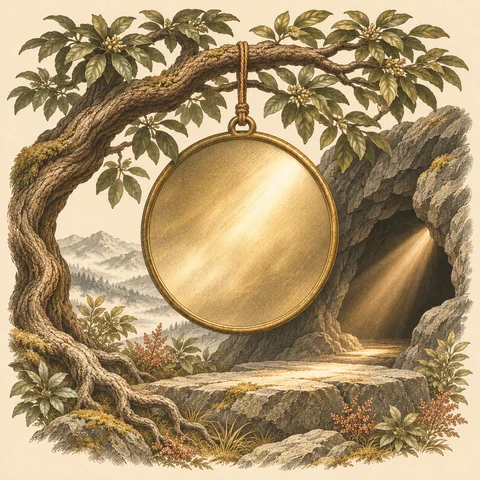
The mirror is commissioned when the deities seek to draw Amaterasu from the rock dwelling. Ishikoridome is charged with making it, while others obtain materials, prepare jewels, perform divination, and arrange offerings. Its effectiveness belongs within this coordinated work. A summary that makes the mirror appear by itself would erase the craft and planning that the passage explicitly distributes among participants.
Source: Kojiki: Records of Ancient Matters, Chamberlain translation · Kojiki §16, preparations
Attention changes a closed situation
After Uzume's performance provokes laughter, Amaterasu opens the entrance and asks what has happened. The mirror is advanced as she hears that a more splendid deity is present. Looking draws her farther out, enabling the assisting deity to take her hand. The object changes what she attends to; the return of light still requires other actions. Its narrative power lies in the sequence, not an independently described ability to compel every viewer.
Source: Kojiki: Records of Ancient Matters, Chamberlain translation · Kojiki §16, emergence
A later instruction changes its status
At the descent, the mirror is entrusted to the expedition with instructions to regard it as Amaterasu's presence and honor it accordingly. The same object now mediates an enduring relation, beyond the immediate crisis for which it was made. These passages explain its significance within the chronicle. They do not themselves establish the identity or material history of any surviving mirror associated with later institutions.
Source: Kojiki: Records of Ancient Matters, Chamberlain translation · Kojiki §33
- Period / witness
- Kojiki presented in 712 CE; Chamberlain translation 1882. Narrative time is not a historical date.
- Recording context
- Kojiki, a Japanese court compilation attributed to Ō no Yasumaro from material recited by Hieda no Are; cited by Chamberlain’s numbered sections, not asserted as the origin of the tradition.
A recording location is not necessarily a story’s origin. Dates of texts, copies, and translations answer different questions.
Explore time & place →Read the sources
These references support the explanation above. Rights and edition notes are recorded individually.
Kojiki: Records of Ancient Matters, Chamberlain translation ↗
Ō no Yasumaro (compiler, as identified in the preface); translated by Basil Hall Chamberlain (1850–1935) · Court compilation presented 712 CE; translation published Yokohama, 1882
Edition & rights note