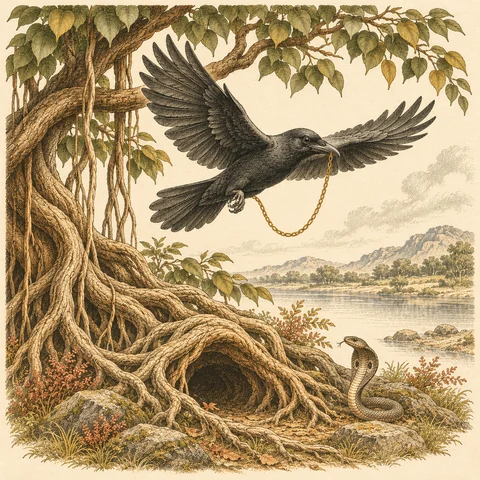
A new explanation for a poor harvest
A Brahman working an unproductive field rests in the heat and sees a snake emerging near an anthill. He decides that it must be the field’s guardian, neglected until now. He brings milk in a dish and asks the being to look favorably on him.
The next morning he finds a gold coin in the dish. Thereafter he visits alone with milk and receives a coin each time. The story describes a sustained exchange rather than a single discovery of buried treasure. The farmer’s interpretation of the snake establishes the relationship, while the repeated return gives him a practical reason to continue the offering. No account of the entire field’s earlier history is supplied.
Source: Panchatantra, Book 3: Crows and Owls · Panchatantra, Book 3, The Snake Who Paid Cash, with conclusion following The Unsocial Swans, pp. 331–334
The son changes the transaction
When the father goes to town, he sends his son to carry the milk. After finding the coin on the following visit, the young man concludes that the anthill must contain a whole store of money. He decides to kill the snake and take everything at once.
During the next offering he strikes it with a cudgel, but fails to kill it. The snake bites him, and he dies. Relatives cremate his body near the field. On returning, the father learns what happened and understands that the attack began with his son’s attempt to replace a continuing relationship with immediate possession. The potential source of future payments has become the survivor of an assault.
Source: Panchatantra, Book 3: Crows and Owls · Panchatantra, Book 3, The Snake Who Paid Cash, with conclusion following The Unsocial Swans, pp. 331–334
An exchange that cannot simply restart
The father later brings milk again and tries to regain the snake’s confidence, attributing his son’s death to the young man’s own conduct. The snake answers with an image of damaged affection: although a funeral fire can be taken apart, a bond broken and repaired remains painful. In this version the conclusion does not provide a cheerful restoration of the earlier routine.
The episode examines the limits of treating trust as a renewable resource after violence. The father’s willingness to resume the material exchange does not erase what has happened to either party. Its position in the debate over an enemy seeking refuge makes the remembered injury politically relevant, while the personal losses prevent the lesson from being reduced to a convenient rule about profitability.
Source: Panchatantra, Book 3: Crows and Owls · Panchatantra, Book 3, The Snake Who Paid Cash, with conclusion following The Unsocial Swans, pp. 331–334
- Period / witness
- Pūrṇabhadra recension dated 1199 CE; Arthur W. Ryder translation, 1925. The tales have differing earlier histories.
- Recording context
- Original synopsis and commentary on Ryder’s translation of the Pūrṇabhadra recension, edited by Johannes Hertel. This selected literary witness does not represent all Indian traditions.
A recording location is not necessarily a story’s origin. Dates of texts, copies, and translations answer different questions.
Explore time & place →Read the sources
These references support the explanation above. Rights and edition notes are recorded individually.
Panchatantra, Book 3: Crows and Owls ↗
Pūrṇabhadra recension (1199 CE); English translation by Arthur W. Ryder (1877–1938), based on Johannes Hertel’s Sanskrit edition · Pūrṇabhadra recension 1199 CE; Hertel edition 1908; Ryder translation 1925
Edition & rights note