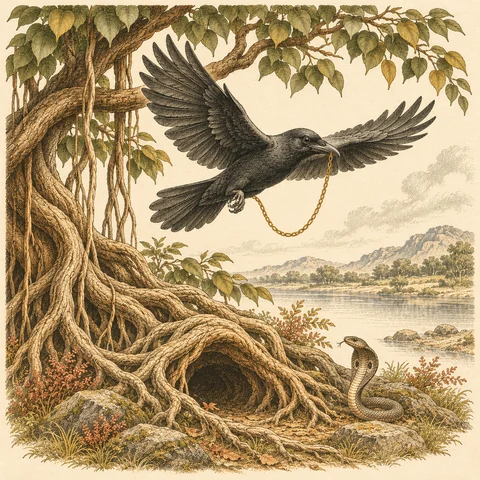
Who owns an empty home?
A partridge leaves its dwelling beneath a tree to feed in a place where rice is abundant. It stays away long enough that its neighbor, the narrator of the episode, fears it has died. A rabbit moves into the vacant hole. When the partridge returns, each animal claims the right to occupy it.
Their dispute takes the form of competing legal arguments. The partridge invokes former ownership and the testimony of neighbors; the rabbit argues that present occupation determines possession among animals. Unable to agree, they go looking for a judge. The narrating bird follows to discover how the disagreement will be resolved, giving the story an observer who can report its ending.
Source: Panchatantra, Book 3: Crows and Owls · Panchatantra, Book 3, The Cat’s Judgment, pp. 315–324
Mercy performed at a useful distance
They approach Curd-Ear, a cat living beside the Ganges under the appearance of religious self-denial. Initially they recognize the danger of consulting a natural predator. The cat responds with a performance of piety and a long discourse condemning harm to living creatures.
The litigants propose that he eat whichever party proves false, but he indignantly rejects the offer. This refusal strengthens the appearance that he has renounced his appetite. He then claims to be too old to hear their statements clearly from a distance. To receive an accurate judgment, he says, they must come close and speak beside his ear. The demand seems procedural, although it removes their physical protection.
Source: Panchatantra, Book 3: Crows and Owls · Panchatantra, Book 3, The Cat’s Judgment, pp. 315–324
No verdict for either claimant
When both come within reach, the cat seizes them and eats them. Their rival claims to the dwelling are never decided. The apparent judge has used their shared desire for a settlement to gain access to both bodies.
The tale’s religious speeches matter because they are specifically contradicted by the speaker’s intention and conduct. It need not be read as proof that all ascetics are fraudulent. Its sharper warning concerns choosing an authority whose interests conflict with the parties’ safety and allowing reassuring language to replace safeguards. In the surrounding political argument, the episode becomes a reason to distrust an unsuitable ruler. The housing quarrel shows how a dispute between neighbors can become worse when it is outsourced to someone who benefits from destroying them both.
Source: Panchatantra, Book 3: Crows and Owls · Panchatantra, Book 3, The Cat’s Judgment, pp. 315–324
- Period / witness
- Pūrṇabhadra recension dated 1199 CE; Arthur W. Ryder translation, 1925. The tales have differing earlier histories.
- Recording context
- Original synopsis and commentary on Ryder’s translation of the Pūrṇabhadra recension, edited by Johannes Hertel. This selected literary witness does not represent all Indian traditions.
A recording location is not necessarily a story’s origin. Dates of texts, copies, and translations answer different questions.
Explore time & place →Read the sources
These references support the explanation above. Rights and edition notes are recorded individually.
Panchatantra, Book 3: Crows and Owls ↗
Pūrṇabhadra recension (1199 CE); English translation by Arthur W. Ryder (1877–1938), based on Johannes Hertel’s Sanskrit edition · Pūrṇabhadra recension 1199 CE; Hertel edition 1908; Ryder translation 1925
Edition & rights note