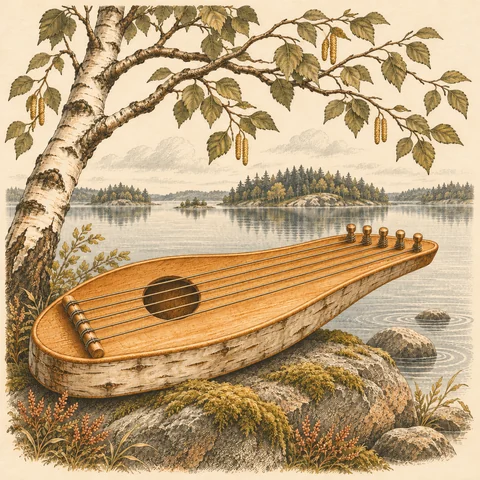
The observer on the shore
Annikki sees Väinämöinen traveling by boat and questions him about his destination. His eventual disclosure reveals that he intends to seek the maiden of Pohjola. She understands the significance for her brother and hurries to Ilmarinen with the news.
The scene turns observation and questioning into consequential action. The contest between suitors does not arise solely from the decisions of two famous men. A woman at the shore identifies the developing situation and makes sure that information reaches someone who can respond. Her role is brief but structurally decisive.
Source: Kalevala, The Land of the Heroes, Volume One · Runo XVIII, lines 41–266
Assistance before the spectacular tasks
Ilmarinen prepares for the journey after the warning and travels toward Pohjola. Annikki’s intervention therefore belongs to the network of assistance that precedes the later trials, just as the maiden’s advice contributes to their successful completion.
The selected episode does not provide an extensive independent biography of the sister. Filling that absence with invented marriages or divine offices would obscure the actual evidence. Her value as a connected article lies in making a less celebrated form of agency visible: attentive questioning and timely communication redirect the story before weapons or forged tools are needed.
Source: Kalevala, The Land of the Heroes, Volume One · Runo XVIII, lines 267–470; compare 41–266
- Period / witness
- Elias Lönnrot’s expanded Kalevala, 1849; W. F. Kirby’s English translation first published 1907. Narrative time is not a historical date.
- Recording context
- A nineteenth-century literary compilation based on Finnish, Karelian, and Ingrian oral poetry. These entries describe the selected compiled epic, not a single unchanged oral text or every living tradition.
A recording location is not necessarily a story’s origin. Dates of texts, copies, and translations answer different questions.
Explore time & place →Read the sources
These references support the explanation above. Rights and edition notes are recorded individually.
Kalevala, The Land of the Heroes, Volume One ↗
Elias Lönnrot (compiler, 1802–1884); translated by William Forsell Kirby (1844–1912) · Expanded Finnish compilation 1849; translation first published 1907; digitized printing lists reprints through 1936
Edition & rights note