Two requests for help
The ruler of Bekhten sends his daughter to the Egyptian king, and she becomes a royal wife. Later, an embassy reports that her younger sister Bentresh is dangerously ill. The king summons learned personnel and sends the skilled scribe Djehutyemheb. On arrival, he finds that the afflicting spirit is beyond his capacity to remove. Bekhten’s ruler therefore sends another appeal, this time asking for a god.
The narrative carefully separates human expertise from the divine authority eventually required. It also makes the request a matter of royal kinship and diplomacy. Gifts, envoys, and travel connect the foreign household with Thebes, while the Egyptian king appears as the person able to mobilize the sanctuary’s help. These are features of the story’s presentation, not independently verified records of a Ramesside medical mission.
Source: Legends of the Gods: The Egyptian Texts, edited with Translations · Chapter VI, Bentresh stela, opening titulary and first two embassies
An image carries effective power
Khonsu in Thebes, called Neferhotep, authorizes another form of Khonsu, the one who determines destinies, to travel. The first image imparts protection to the second. With an escort, the traveling god reaches Bekhten and heals Bentresh. The spirit acknowledges the god’s superiority and agrees to depart, but asks for a celebratory offering. Khonsu approves, a feast is held, and the spirit leaves peacefully.
The cure is thus followed by negotiation and ritual hospitality. The narrative does not end with the simple destruction of an enemy. The ruler is so pleased that he keeps the divine image in his country. What began as a borrowed source of assistance becomes something he wants to possess permanently, even though the arrangements had depended on the authority of the Theban sanctuary.
Source: Legends of the Gods: The Egyptian Texts, edited with Translations · Chapter VI, authorization of Khonsu Pa-ari-sekher, healing and the spirit’s departure
A departure dreamed before it happens
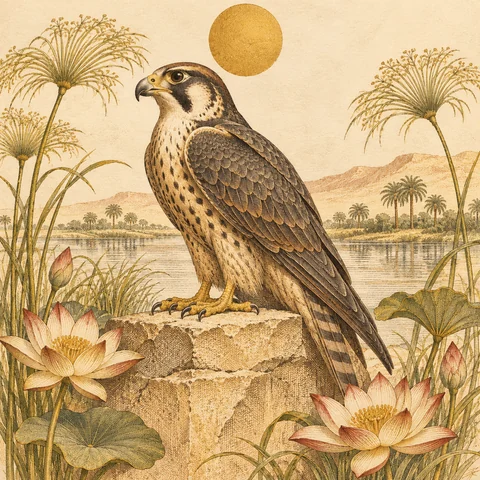
After three years and nine months, the ruler dreams that the god leaves the shrine as a golden falcon and flies toward Egypt. He wakes frightened and permits the image to return. The gifts brought back are presented to Khonsu Neferhotep, and the traveling manifestation reaches its own sanctuary. The cure is complete, but its power cannot simply be detained by a grateful foreign ruler.
The stone speaks in the name and regnal years of Ramesses II, whereas the Louvre regards the object as later. Its catalogue tentatively assigns a Twenty-first Dynasty date and explicitly acknowledges the Persian or Ptolemaic datings often proposed. That disagreement belongs in the reading, not in a hidden footnote. The story establishes the prestige and relationships of Khonsu’s manifestations through a royal past; it is unsafe to treat its dates as a straightforward historical itinerary.
Sources: Legends of the Gods: The Egyptian Texts, edited with Translations; Stèle de Bakhtan, E 13481 / C 284 · Chapter VI, golden-falcon dream and return; Louvre, “Places and dates” and “Inscriptions”
- Period / witness
- Story set under Ramesses II; surviving stela is later and its date is disputed.
- Recording context
- Stèle de Bakhtan, Louvre E13481/C284, found in the small temple of Khonsu at Karnak. Louvre tentatively lists Dynasty 21 while noting Persian or Ptolemaic datings.
A recording location is not necessarily a story’s origin. Dates of texts, copies, and translations answer different questions.
Explore time & place →Read the sources
These references support the explanation above. Rights and edition notes are recorded individually.
Legends of the Gods: The Egyptian Texts, edited with Translations ↗
E. A. Wallis Budge (1857–1934) · 1912; digital edition updated 2021
Edition & rights noteStèle de Bakhtan, E 13481 / C 284 ↗
Musée du Louvre, Département des Antiquités égyptiennes · Catalogue gives Dynasty 21 tentatively and notes Persian or Ptolemaic alternatives; page consulted 2026
Edition & rights note