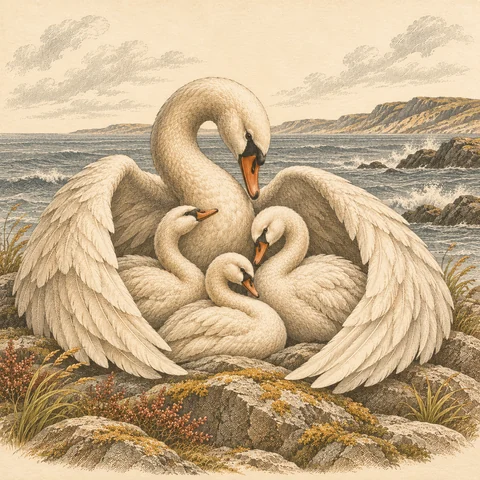
Love recruited into a military plan
Ailill and Medb require cattle to feed the forces assembling for the great raid on Cúailnge. They identify Regamon, a wealthy Connacht landholder, as a possible source. Their seven sons love his seven daughters, so the royal parents make that relationship part of their strategy. Affection and filial duty become reasons to send inexperienced young men into a dangerous neighboring territory.
The sons do not all respond identically. One emphasizes duty to his parents; another asks what reward will justify the risk and admits that they have been sheltered from war. Their hesitation makes the expedition more than an effortless display of inherited heroism. The company must learn how to operate beyond the protection of its household.
Source: The Raid for the Cattle of Regamon — Leahy translation · Táin Bó Regamon, literal translation: royal council, seven sons and daughters, objections before departure
The daughters move the herds
Scouts encounter three daughters at the water and initially threaten them with swords. Recognition changes the conversation, but the opening coercion should not disappear beneath the later language of romance. The young women consult their sisters and decide to assist the visitors. They assemble cattle, pigs, and sheep and bring them secretly to the departing company.
The party divides to move more easily. Regamon returns from a separate meeting, pursues, and catches one group. The sons send for one another while the daughters continue with the herds to Cruachan. There the women report the danger and obtain help. Their movement of both livestock and information is what makes rescue possible; they are active participants in the expedition's survival.
Source: The Raid for the Cattle of Regamon — Leahy translation · Táin Bó Regamon, literal translation: encounter at the spring, sisters’ council, divided departure and message to Cruachan
A settlement after the threatened battle
The young men defend a ford with hurdles until the royal army arrives. The makeshift barrier supplies a place-name in the telling, linking the memory of their predicament to the landscape. The opposing forces do not simply fight until one side is destroyed. They reach an agreement that recognizes both the young people's marriages and Regamon's claim to his property.
The herd is restored, while a specified number of milk cows passes as the daughters' marriage provision and support for the projected campaign. The settlement separates outright seizure from an agreed transfer. As one of the preludes to the Táin, the story explains how military resources are assembled, while showing that an apparently local marriage arrangement can sustain a much larger conflict.
Source: The Raid for the Cattle of Regamon — Leahy translation · Táin Bó Regamon, literal translation: hurdle defense, relief, restitution and marriage cattle; concluding identification as a Táin prelude
- Period / witness
- Medieval Irish prose and verse preserved in medieval and early modern manuscript witnesses; Leahy translation 1905–1906.
- Recording context
- This entry concerns the literary version named in its passages, transmitted by Christian-era Irish manuscript culture and translated by A. H. Leahy. Legendary settings are not dates of composition or evidence for a single pre-Christian canon.
A recording location is not necessarily a story’s origin. Dates of texts, copies, and translations answer different questions.
Explore time & place →Read the sources
These references support the explanation above. Rights and edition notes are recorded individually.
The Raid for the Cattle of Regamon — Leahy translation ↗
Anonymous Irish literary narratives; translated and arranged by Arthur Herbert Leahy (1857–1928) · Volume II, 1906; Project Gutenberg eBook released May 2004 and updated 29 June 2026
Edition & rights note