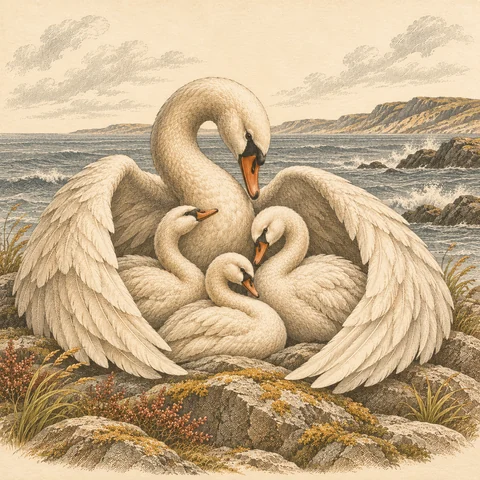
Desire conveyed from a distance
Flidais is married to Ailill Finn when reports of Fergus's exploits lead her to send messages to him. Her interest helps motivate the visit that produces the raid. The husband reads even a request for cattle through the possibility of losing her, so private attraction changes the meaning of public hospitality before she enters the combat scene herself.
Source: The Driving of the Cattle of Flidais — Leahy translation · Táin Bó Flidais, literal translation: opening messages and Ailill Finn’s response to Fergus
Care across the line of battle
After her husband defeats the visitors, Flidais covers the wounded men with her cloak and undertakes their healing. This act does not stop the eventual siege, but it prevents the injured figures from disappearing into a simple division between winners and losers. Her work sustains people whom the household's armed defenders have treated as enemies.
Source: The Driving of the Cattle of Flidais — Leahy translation · Táin Bó Flidais, literal translation: defeated visitors, covering cloak and treatment in the castle
Provision rather than an unlimited divine portfolio
Following the conquest, Flidais goes with Fergus, and her cows repeatedly feed the forces preparing for the Táin. The closing notice emphasizes her continuing support of his household and the deterioration after her death. This witness supports attention to wealth, nurture, and alliance. It does not by itself establish every later generalized description of Flidais as a goddess governing all animals or all nature.
Source: The Driving of the Cattle of Flidais — Leahy translation · Táin Bó Flidais, literal translation: transfer after the sack, periodic provision and death notice
- Period / witness
- Medieval Irish prose and verse preserved in medieval and early modern manuscript witnesses; Leahy translation 1905–1906.
- Recording context
- This entry concerns the literary version named in its passages, transmitted by Christian-era Irish manuscript culture and translated by A. H. Leahy. Legendary settings are not dates of composition or evidence for a single pre-Christian canon.
A recording location is not necessarily a story’s origin. Dates of texts, copies, and translations answer different questions.
Explore time & place →Read the sources
These references support the explanation above. Rights and edition notes are recorded individually.
The Driving of the Cattle of Flidais — Leahy translation ↗
Anonymous Irish literary narratives; translated and arranged by Arthur Herbert Leahy (1857–1928) · Volume II, 1906; Project Gutenberg eBook released May 2004 and updated 29 June 2026
Edition & rights note