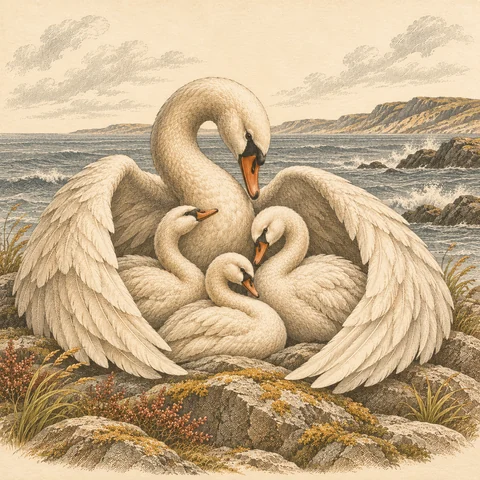
A preference within a royal household
Findabair loves Fráech from reports of his accomplishments. When he approaches her privately, she welcomes him but refuses to elope, asserting that her royal parentage makes a recognized marriage possible. She gives him a ring as a token. Her refusal does not reject the man; it distinguishes the relationship she wants from the method he proposes for obtaining it.
Source: The Raid for the Cattle of Fraech — Leahy translation · Táin Bó Fraích, literal translation, first section: report of love and conversation at the water
Acting when the spectators cannot
The marriage negotiations fail, and Ailill places Fráech in the water monster's reach. Findabair carries a sword to him when no man ashore will do so. Her father's spear passes through her hair. The incident gives a physical form to the conflict between paternal authority and her chosen attachment: assisting the guest requires exposing herself to violence from her own household.
Source: The Raid for the Cattle of Fraech — Leahy translation · Táin Bó Fraích, literal translation, first section: monster, sword and Ailill’s spear
Evidence that changes the negotiation
Ailill later demands the ring he knows he has thrown away and threatens her life if she cannot produce it. Fráech has recovered the salmon that swallowed it, allowing her servant to bring it back during the feast. The public appearance of the object overturns the fabricated impossibility. The renewed marriage agreement nevertheless remains tied to future military service, leaving personal choice inside an ongoing political bargain.
Source: The Raid for the Cattle of Fraech — Leahy translation · Táin Bó Fraích, literal translation, first section: ring demand, prepared salmon and final marriage terms
- Period / witness
- Medieval Irish prose and verse preserved in medieval and early modern manuscript witnesses; Leahy translation 1905–1906.
- Recording context
- This entry concerns the literary version named in its passages, transmitted by Christian-era Irish manuscript culture and translated by A. H. Leahy. Legendary settings are not dates of composition or evidence for a single pre-Christian canon.
A recording location is not necessarily a story’s origin. Dates of texts, copies, and translations answer different questions.
Explore time & place →Read the sources
These references support the explanation above. Rights and edition notes are recorded individually.
The Raid for the Cattle of Fraech — Leahy translation ↗
Anonymous Irish literary narratives; translated and arranged by Arthur Herbert Leahy (1857–1928) · Volume II, 1906; Project Gutenberg eBook released May 2004 and updated 29 June 2026
Edition & rights note