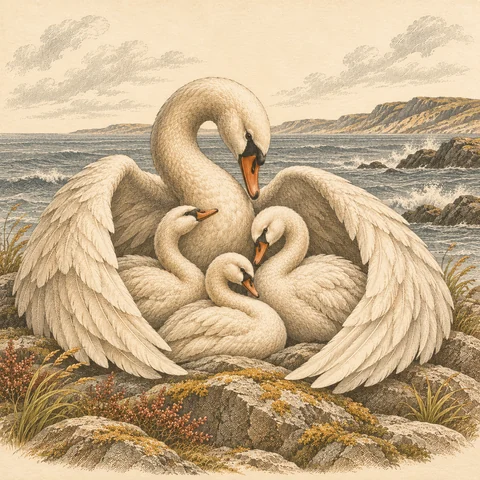
A life narrated before it begins
Cathbad's prophecy identifies Deirdre with future disaster before she is born. Conchobar answers the threat by controlling her upbringing and reserving her as his own future wife. This arrangement makes her beauty a political problem defined by others. The later narrative should not simply adopt the prophecy's blame as proof that she causes every violent choice made around her.
Source: The Exile of the Sons of Usnach: Book of Leinster version — Leahy translation · Book of Leinster version: prenatal cry, prophecy and Conchobar’s secluded upbringing plan
Choosing does not remove coercion
Deirdre seeks Naoise after Leabharcham identifies the man who matches her imagined beloved. She forces the issue through a threat of shame, and the brothers leave with her. In Alba she protects the group by reporting the king's attempts to obtain her. Her initiative is substantial, but it operates within a world where powerful men repeatedly treat her marriage as something they can command.
Source: The Exile of the Sons of Usnach: Book of Leinster version — Leahy translation · Book of Leinster version: meeting Naoise, departure and warnings during service in Alba
Memory as a refusal
After the killings, Deirdre's laments measure palace entertainments against meals, songs, and shared work in exile. Material splendor cannot make Conchobar's household a replacement for the chosen one. Leahy's Book of Leinster ending gives her a violent death after transfer to Naoise's killer; a separate later conclusion appears elsewhere in his volume and should not be merged with this witness.
Source: The Exile of the Sons of Usnach: Book of Leinster version — Leahy translation · Book of Leinster version: year in Conchobar’s household, laments, Eogan and death
- Period / witness
- Medieval Irish prose and verse preserved in medieval and early modern manuscript witnesses; Leahy translation 1905–1906.
- Recording context
- This entry concerns the literary version named in its passages, transmitted by Christian-era Irish manuscript culture and translated by A. H. Leahy. Legendary settings are not dates of composition or evidence for a single pre-Christian canon.
A recording location is not necessarily a story’s origin. Dates of texts, copies, and translations answer different questions.
Explore time & place →Read the sources
These references support the explanation above. Rights and edition notes are recorded individually.
The Exile of the Sons of Usnach: Book of Leinster version — Leahy translation ↗
Anonymous Irish literary narratives; translated and arranged by Arthur Herbert Leahy (1857–1928) · Volume I, 1905; Project Gutenberg eBook released May 2004 and updated 29 June 2026
Edition & rights note