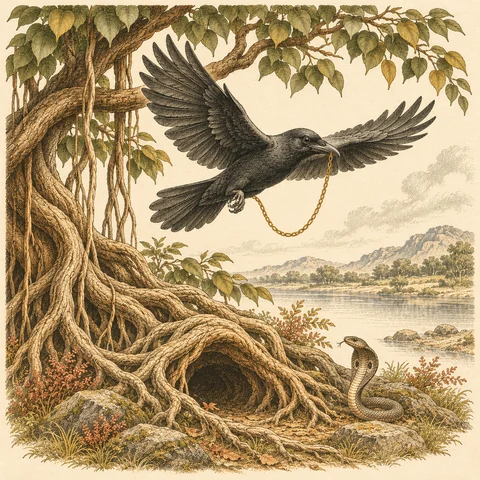
A craftsman makes an entrance
A weaver sees Princess Lovely during a festival and becomes overwhelmed by desire for her. His friend, a carpenter, constructs a wooden flying bird resembling Garuda and equips him with the appearance and emblems of Vishnu. The device carries the weaver to the princess’s private balcony.
Believing the visitor divine, she asks what he wishes. He claims that she is his heavenly wife temporarily living on earth and proposes marriage. She accepts on that false understanding. Their repeated secret meetings eventually attract attention. When her parents learn her account and watch his arrival, they also mistake the manufactured spectacle for an actual visit by Vishnu.
Source: Panchatantra, Book 1: The Loss of Friends · Panchatantra, Book 1, The Weaver Who Loved a Princess, pp. 89–112
A private deception becomes a war
The king now imagines that a divine son-in-law guarantees his power. He refuses the tribute owed to a stronger ruler, Valor, whose army invades. The princess asks her supposed god to defend the city. The weaver promises victory, then privately recognizes that fleeing would abandon her while fighting could kill him.
He resolves to appear on the wooden bird and risk battle. Meanwhile the real Garuda warns Vishnu that the impostor’s defeat would be mistaken for the god’s death, damaging worship. Vishnu decides to inhabit the weaver; Garuda enters the mechanical bird, and divine force enters the imitation discus. What began as a prop acquires the power it falsely advertised.
Source: Panchatantra, Book 1: The Loss of Friends · Panchatantra, Book 1, The Weaver Who Loved a Princess, pp. 89–112
Success without disclosure
In battle the weaver kills Valor with the discus. The defeated rulers submit, the princess’s father receives the conquered wealth, and the weaver continues to enjoy his marriage. This witness does not end with the exposure and punishment familiar from many impostor stories.
The unusual rescue makes the narrative more troubling than a simple celebration of resourcefulness. The princess’s agreement rests on deception, while her father’s political confidence costs his subjects an invasion. Vishnu’s intervention protects divine reputation as well as the weaver’s undertaking. The story deliberately pushes a successful false appearance beyond ordinary likelihood: even heavenly observers have difficulty explaining what they see. Its gods and machinery belong to this literary episode, not to a technical account of historical flight.
Source: Panchatantra, Book 1: The Loss of Friends · Panchatantra, Book 1, The Weaver Who Loved a Princess, pp. 89–112
- Period / witness
- Pūrṇabhadra recension dated 1199 CE; Arthur W. Ryder translation, 1925. The tales have differing earlier histories.
- Recording context
- Original synopsis and commentary on Ryder’s translation of the Pūrṇabhadra recension, edited by Johannes Hertel. This selected literary witness does not represent all Indian traditions.
A recording location is not necessarily a story’s origin. Dates of texts, copies, and translations answer different questions.
Explore time & place →Read the sources
These references support the explanation above. Rights and edition notes are recorded individually.
Panchatantra, Book 1: The Loss of Friends ↗
Pūrṇabhadra recension (1199 CE); English translation by Arthur W. Ryder (1877–1938), based on Johannes Hertel’s Sanskrit edition · Pūrṇabhadra recension 1199 CE; Hertel edition 1908; Ryder translation 1925
Edition & rights note