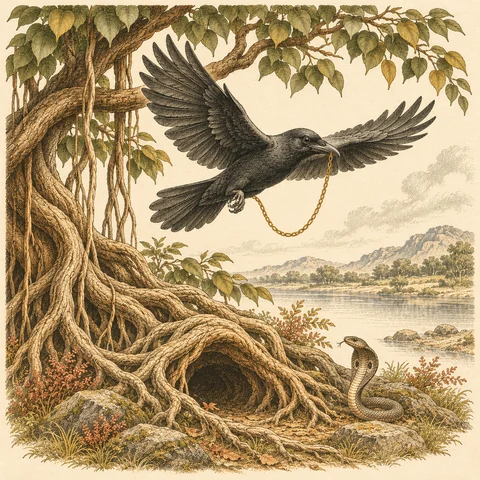
A rescued animal becomes a daughter
A small female mouse falls from a hawk’s beak into the hand of Yajnavalkya, a holy man beside the Ganges. Through his powers he changes her into a human girl and entrusts her to his childless wife. The couple rear her as their daughter.
When the narrative considers her ready to marry, the parents discuss a suitable husband. The surrounding verses endorse very early marriage, a historical prescription that the atlas does not adopt. The father proposes the Sun as a magnificent match, provided the girl agrees. His search starts with an apparently supreme cosmic power rather than with someone whose manner of life resembles the household in which she has grown up.
Source: Panchatantra, Book 3: Crows and Owls · Panchatantra, Book 3, Mouse-Maid Made Mouse, pp. 353–359
Every superiority has a limit
The girl rejects the Sun because of his heat. Asked whether anyone surpasses him, the Sun names the cloud that can obscure him. The cloud is rejected in turn and names the wind that carries it away. The wind points to the mountain that withstands its force, but the mountain’s roughness and stiffness also displease the girl.
The mountain finally acknowledges the mouse, which can burrow through it. Each proposed superiority is therefore relative to a particular action. Brightness can be covered; a covering can be moved; movement can be resisted; resistance can be penetrated. The sequence dismantles the assumption that one being must possess every kind of strength at once.
Source: Panchatantra, Book 3: Crows and Owls · Panchatantra, Book 3, Mouse-Maid Made Mouse, pp. 353–359
A return chosen within the tale
On seeing the mouse brought before her, the girl responds with immediate affinity. She asks to be made a mouse again so that she can marry him and live as his kind does. Yajnavalkya grants the transformation and arranges the union.
In the surrounding debate, this ending is used to support an argument about persistent nature beneath changed appearance. That narrative argument should not be converted into a social rule that human birth determines a person’s proper spouse or capacities. Within the episode, the girl repeatedly voices preferences and finally requests the form that makes her desired household possible. The cosmic search ends with compatibility rather than with the discovery of a universally unbeatable husband, even as its framing draws a more essentialist lesson.
Source: Panchatantra, Book 3: Crows and Owls · Panchatantra, Book 3, Mouse-Maid Made Mouse, pp. 353–359
- Period / witness
- Pūrṇabhadra recension dated 1199 CE; Arthur W. Ryder translation, 1925. The tales have differing earlier histories.
- Recording context
- Original synopsis and commentary on Ryder’s translation of the Pūrṇabhadra recension, edited by Johannes Hertel. This selected literary witness does not represent all Indian traditions.
A recording location is not necessarily a story’s origin. Dates of texts, copies, and translations answer different questions.
Explore time & place →Read the sources
These references support the explanation above. Rights and edition notes are recorded individually.
Panchatantra, Book 3: Crows and Owls ↗
Pūrṇabhadra recension (1199 CE); English translation by Arthur W. Ryder (1877–1938), based on Johannes Hertel’s Sanskrit edition · Pūrṇabhadra recension 1199 CE; Hertel edition 1908; Ryder translation 1925
Edition & rights note