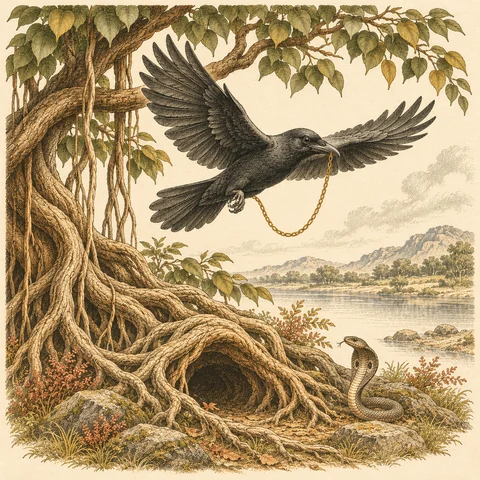
Affection beside unresolved fear
A Brahman’s wife cares for both her infant son and a young mongoose, tending the animal with unusual affection. Nevertheless, she fears that its nature might make it dangerous to the baby. When she goes to fetch water, she instructs her husband to watch the child. He leaves to seek food, and the household is unattended by either parent.
A black snake emerges and approaches the cradle. The mongoose attacks it, kills it, and scatters the pieces. The narrator presents the action as defense of the baby, whom the animal regards as a brother. The danger anticipated by the mother has come from another creature entirely.
Source: Panchatantra, Book 5: Ill-considered Action · Panchatantra, Book 5, The Loyal Mungoose, pp. 432–434
An irreversible reading of the evidence
Excited by what it has done, the mongoose runs out to meet the returning mother. Blood still marks its mouth. She interprets that sight through the fear she already carried: the animal must have killed her child. Without going inside to check, she drops the heavy water vessel on it and kills it.
Only afterward does she reach the cradle. The baby is unharmed, and the snake’s remains reveal the mongoose’s intervention. The evidence now supports the opposite account, but it arrives too late to repair her action. She laments the animal as both her benefactor and another child she has lost. Its loyalty receives recognition only after its death.
Source: Panchatantra, Book 5: Ill-considered Action · Panchatantra, Book 5, The Loyal Mungoose, pp. 432–434
Responsibility shared, loss unrepaired
When the father returns with food, his wife reproaches him for leaving despite her instructions. The discussion leads into a story about excessive desire and the pursuit of wealth. That framing connects the catastrophe with his absence as well as her immediate judgment.
The tale does not undo the death through a supernatural restoration. Its force lies in the gap between seeing a sign and establishing what produced it. Blood is real evidence of violence but does not identify the victim or aggressor on its own. The mother’s protective purpose cannot make the blow reversible. By placing the safe child and dead defender in the same household, the ending makes a correct conclusion reached too late as painful as the initial mistake.
Source: Panchatantra, Book 5: Ill-considered Action · Panchatantra, Book 5, The Loyal Mungoose, pp. 432–434
- Period / witness
- Pūrṇabhadra recension dated 1199 CE; Arthur W. Ryder translation, 1925. The tales have differing earlier histories.
- Recording context
- Original synopsis and commentary on Ryder’s translation of the Pūrṇabhadra recension, edited by Johannes Hertel. This selected literary witness does not represent all Indian traditions.
A recording location is not necessarily a story’s origin. Dates of texts, copies, and translations answer different questions.
Explore time & place →Read the sources
These references support the explanation above. Rights and edition notes are recorded individually.
Panchatantra, Book 5: Ill-considered Action ↗
Pūrṇabhadra recension (1199 CE); English translation by Arthur W. Ryder (1877–1938), based on Johannes Hertel’s Sanskrit edition · Pūrṇabhadra recension 1199 CE; Hertel edition 1908; Ryder translation 1925
Edition & rights note