A gift designed as repayment
After Prometheus steals fire, Zeus announces a repayment that mortals will embrace. Hephaestus forms a woman from earth and water. Athena teaches her work, Aphrodite adds desire, and Hermes supplies speech and a deceitful disposition. The adornment is a coordinated divine undertaking. The gods give her the name Pandora, which the poem connects to their gifts.
Prometheus has warned his brother Epimetheus against accepting a gift from Zeus. Epimetheus nevertheless receives her, and understands the harm only afterward. The contrast between the brothers’ names and their different responses encourages the reader to notice foresight and hindsight, rather than treating the gift as an isolated accident.
Source: Works and Days, in Hesiod, the Homeric Hymns, and Homerica · Works and Days 47–89
What comes out of the vessel
Pandora removes the lid of a large jar. Afflictions spread among humans, who had previously lived without this burden of toil and disease. Hope remains inside under the rim when the lid is replaced, in accordance with Zeus’s will. The poem then describes troubles wandering the world and diseases arriving without voices. Its force lies partly in that loss of warning: danger can arrive without announcing itself.
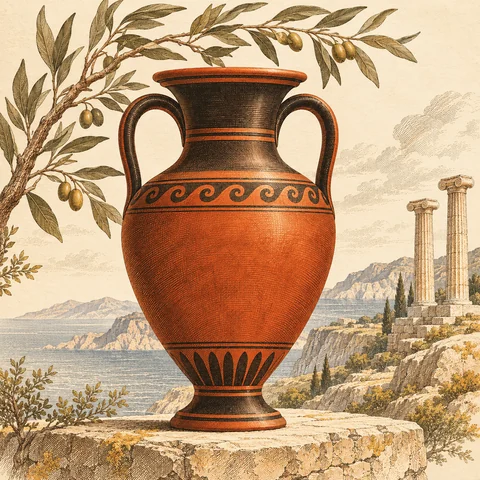
The object in this Greek account is a storage jar, a pithos, rather than the small box of many modern retellings. The passage does not provide the familiar elaborate instruction that curiosity must never lead Pandora to open a forbidden box. It gives the opening and its consequences without that developed scene.
Source: Works and Days, in Hesiod, the Homeric Hymns, and Homerica · Works and Days 90–105
Is remaining hope a consolation?
The poem’s wording leaves room for disagreement. Hope may seem protected for human use, or withheld where humans cannot obtain it; the term can also involve expectation rather than simply cheerful confidence. A reader should distinguish these interpretations from the clear narrative fact: Hope stays in the jar while the other contents escape. The atlas does not resolve this ambiguity by inventing a final speech in which Hope promises to comfort everyone.
Keeping an unanswered question visible makes the ancient text more interesting. A supposedly definitive retelling can erase precisely the detail that has made readers argue.
Source: Works and Days, in Hesiod, the Homeric Hymns, and Homerica · Works and Days 96–100
Whose explanation is this?
Works and Days addresses livelihood, justice, and the need to work. Its Pandora episode explains present hardship through a highly unequal account of gender. The woman is manufactured as a divine instrument and then made to bear the explanatory weight of human misery. This is evidence for the poem’s rhetoric, not a neutral statement about women or a belief shared identically by every Greek person. Compare the related but unnamed woman in the Theogony to see how one literary tradition can make different uses of a similar figure.
Sources: Works and Days, in Hesiod, the Homeric Hymns, and Homerica; Theogony, in Hesiod, the Homeric Hymns, and Homerica · Works and Days 42–105; Theogony 570–612
- Period / witness
- Works and Days: conventionally around 700 BCE
- Recording context
- A Greek didactic poem associated with Hesiod and Boeotia; no historical first woman or original jar is implied.
A recording location is not necessarily a story’s origin. Dates of texts, copies, and translations answer different questions.
Explore time & place →Read the sources
These references support the explanation above. Rights and edition notes are recorded individually.
Works and Days, in Hesiod, the Homeric Hymns, and Homerica ↗
Hesiod; translated by Hugh G. Evelyn-White · Ancient poem conventionally dated around 700 BCE; translation 1914; digital edition updated 2020
Edition & rights noteTheogony, in Hesiod, the Homeric Hymns, and Homerica ↗
Hesiod; translated by Hugh G. Evelyn-White · Ancient poem conventionally dated around 700 BCE; translation 1914; digital edition updated 2020
Edition & rights note