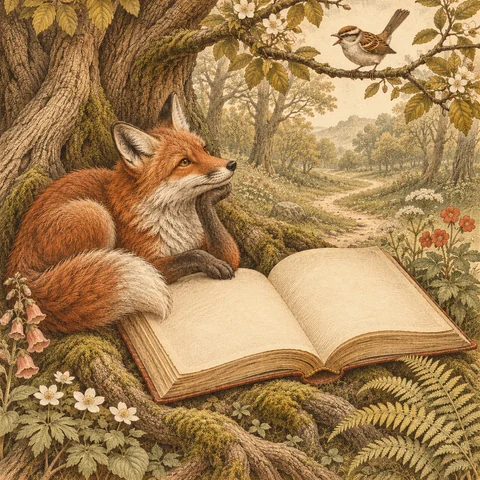
The promise and the judges
A tiger begs a passing Brahman to open his cage. He promises gratitude, and the man releases him. As soon as the tiger is free, hunger overrides the promise: he intends to eat his rescuer. The man asks whether that is a just return for a kindness. The tiger permits an appeal to other witnesses.
A pipal tree describes its shade being enjoyed while its branches are cut. A buffalo recalls giving milk and then being worked and neglected. A road tells of the people who use and injure it. These responses do not save the Brahman. They also complicate an easy division between a civilized human and an unreasonable beast. The witnesses recognize exploitation from their own experience. Their answers make the story's immediate rescue harder while widening the question of reciprocity.
The Brahman meets a jackal who seems unable to understand the sequence. Explanations lead everyone back to the cage. The jackal continues to muddle the roles: which creature was inside, and where was everyone standing? Irritated, the tiger finally enters the cage to demonstrate. The jackal closes the door. His apparent stupidity has produced the only practical answer to an argument the man could not win.
Source: Indian Fairy Tales · “The Tiger, the Brahman, and the Jackal,” pp. 66–69
A reversal, not a simple verdict
The jackal does not prove that every statement made by the other witnesses was false. He changes the physical situation. The rescue is therefore an example of strategic performance: intelligence hides under a failure to understand. It belongs beside other trickster tales, but the role of the trick differs from Anansi's theft and scapegoating. Here it saves a threatened person.
Jacobs's notes trace his immediate source to the Punjabi collection associated with Flora Annie Steel and Richard Carnac Temple. His introduction also advances broad theories about India as a source of European tales. Those theories should not be repeated as established fact. We can identify a printed transmission used by this editor without inferring that every analogous trapped-animal story travelled along the same route. The tale's human title names a Brahman; the plot does not represent all Hindu religious thought.
Source: Indian Fairy Tales · Notes IX; introduction; named tale
- Period / witness
- Jacobs edition 1892
- Recording context
- English collection published in London; Jacobs identifies a Punjabi collection behind this tale. Publication location is not story origin.
A recording location is not necessarily a story’s origin. Dates of texts, copies, and translations answer different questions.
Explore time & place →Read the sources
These references support the explanation above. Rights and edition notes are recorded individually.