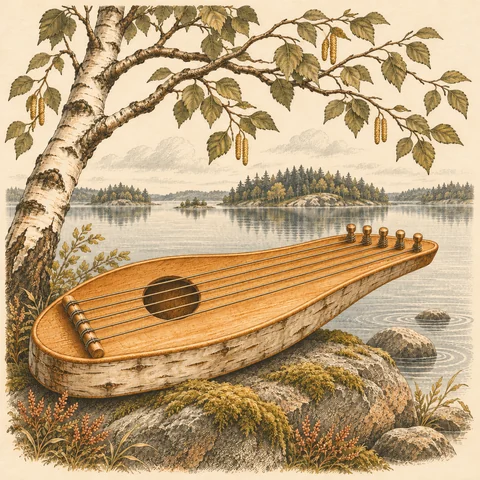
A boundary with demanding keepers
Väinämöinen goes to Tuonela seeking the words needed for his boat. The ferrier questions his presence because he has not died, and his false explanations are exposed through the absence of expected bodily signs. Admission does not make the place hospitable: the drink is repellent and escape is obstructed.
The episode distinguishes crossing a boundary from obtaining what one came for. Väinämöinen returns alive but still needs another source for the missing words. His warning afterward emphasizes the exceptional danger rather than inviting others to repeat the journey.
Source: Kalevala, The Land of the Heroes, Volume One · Runo XVI, lines 119–412
A river that can be searched
Lemminkäinen’s death places his scattered remains in Tuonela’s river. His mother does not follow the same route as Väinämöinen or ask for the same favor. She gathers information, obtains tools, retrieves the body, and restores it with help from the bee.
These different episodes should not be flattened into a single set of travel rules. The river, its inhabitants, and its hazards serve distinct narrative purposes. Tuonela marks a limit against which knowledge and care are tested; survival is extraordinary, and its representation does not establish a complete doctrine governing every dead person.
Source: Kalevala, The Land of the Heroes, Volume One · Runos XIV 373–460; XV
- Period / witness
- Elias Lönnrot’s expanded Kalevala, 1849; W. F. Kirby’s English translation first published 1907. Narrative time is not a historical date.
- Recording context
- A nineteenth-century literary compilation based on Finnish, Karelian, and Ingrian oral poetry. These entries describe the selected compiled epic, not a single unchanged oral text or every living tradition.
A recording location is not necessarily a story’s origin. Dates of texts, copies, and translations answer different questions.
Explore time & place →Read the sources
These references support the explanation above. Rights and edition notes are recorded individually.
Kalevala, The Land of the Heroes, Volume One ↗
Elias Lönnrot (compiler, 1802–1884); translated by William Forsell Kirby (1844–1912) · Expanded Finnish compilation 1849; translation first published 1907; digitized printing lists reprints through 1936
Edition & rights note