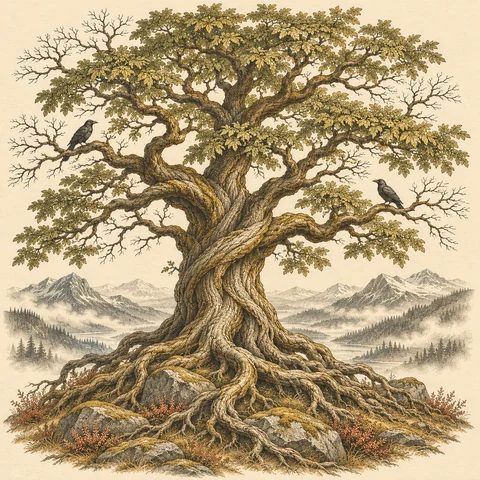
A threat raised at home
The gods learn that Loki’s children by Angrboða will bring them disaster. Odin sends the serpent into the sea and Hel to the realm of the dead, but the wolf Fenrir grows up among the gods. Týr alone is willing to feed him. As the wolf’s size and strength increase, the gods decide to bind him.
Their first two restraints fail. They present each as an opportunity for Fenrir to demonstrate his power, and he breaks them. Then the gods obtain Gleipnir, a deceptively soft band made by dwarfs from impossible ingredients, including the sound of a cat’s footsteps and the roots of a mountain. Its appearance conceals the power that ordinary chains lacked.
Source: The Younger Edda / Prose Edda (1901 printing) · Gylfaginning, chapter IX, §§34–35 in Anderson
A pledge that will be broken
On an island, the gods challenge Fenrir to break the slender band. He suspects enchantment and sees little honor in the test: breaking something so slight would win him little fame, while failure could leave him trapped. The gods promise to free him if he cannot escape. Fenrir demands a tangible guarantee: one of them must put a hand in his mouth.
The gods hesitate. Týr offers his right hand. When Fenrir struggles, Gleipnir tightens instead of breaking. The gods do not release him; Týr loses the hand he pledged. The others secure the restraint and put a sword between the wolf’s jaws. He remains bound until the final crisis, when the bonds of the world fail.
Source: The Younger Edda / Prose Edda (1901 printing) · Gylfaginning, chapter IX, §35; chapter XVI, §§55–56 in Anderson
Protection bought through betrayal
The prose narrator presents the gods as defending themselves against a foretold enemy. Yet the scene also lets the wolf articulate a reasonable fear: their guarantee will not be honored. Týr’s courage is inseparable from that deception. Reading the episode only as a heroic victory discards its most difficult transaction.
The text does not tell us that the binding causes Ragnarök, or that the gods could have permanently avoided the prophecy by treating Fenrir differently. Those are possible modern questions, not answers supplied by the narrative. Its clear outcome is a postponement purchased at bodily cost.
The full sequence of failed chains, dwarf-made restraint, and hand-pledge belongs to Gylfaginning. Lokasenna alludes to Týr’s missing hand, while Völuspá announces the breaking of bonds and the wolf’s release. These brief poetic references support a wider narrative setting without reproducing every detail of the prose story.
Sources: The Poetic Edda (1923 translation); The Younger Edda / Prose Edda (1901 printing) · Lokasenna 38–39; Völuspá 44; Gylfaginning, chapter VIII, §25 and chapter IX, §35
- Period / witness
- Full narrative in the Prose Edda, composed c.1220; surviving principal copies begin around 1300. Earlier oral development is uncertain.
- Recording context
- Iceland: Prose Edda composition and manuscript transmission. No physical location of the mythic events is asserted.
A recording location is not necessarily a story’s origin. Dates of texts, copies, and translations answer different questions.
Explore time & place →Read the sources
These references support the explanation above. Rights and edition notes are recorded individually.
The Younger Edda / Prose Edda (1901 printing) ↗
Snorri Sturluson (1179–1241); translated by Rasmus B. Anderson (1846–1936) · 1901 printing of Anderson’s translation (copyright 1879); medieval work composed in Iceland around the 1220s
Edition & rights noteThe Poetic Edda (1923 translation) ↗
Anonymous Old Norse poets; translated by Henry Adams Bellows (1885–1939) · 1923 translation; medieval poems preserved principally in manuscripts of the thirteenth century
Edition & rights note